The Sacrifice Mandate
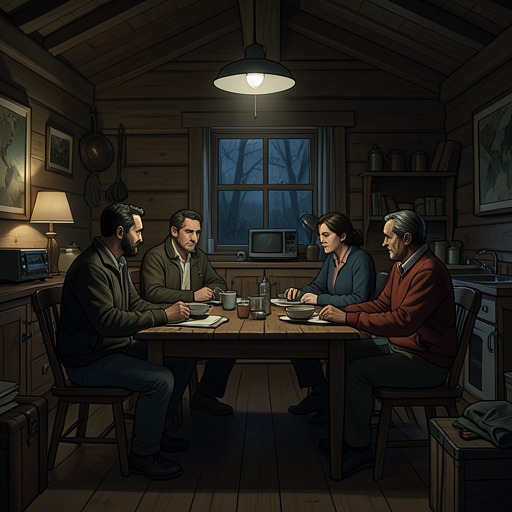
The Cabin at the End of the WorldThe Sacrifice Mandate is the rule Leonard presents to Andrew, Eric, and Wen as the condition for preventing the end of the world. It demands that the family choose one of its three members and carry out the killing themselves; if they refuse or fail to act, Leonard says, humanity will perish while the three remain alive to witness the aftermath. The mandate’s central tension is built into its terms: the visitors call the decision voluntary and necessary, but impose it while holding the family in the cabin and insisting that time is running out.
Terms of the Mandate
Leonard lays out the demand in stark, conditional terms. The family must willingly select one of its own, then kill that person. A failure either to make the selection or to complete the act, he says, will bring about the world’s destruction. The stated consequence is not the family’s immediate death: Leonard says Andrew, Eric, and Wen would live long enough to experience the end of everything and remain alone in the devastated world. The threat thus makes the family responsible, in the visitors’ account, both for choosing a victim and for the fate of everyone beyond the cabin.
The word willingly does important work in this formulation. Leonard presents the family’s participation as indispensable, not as a decision the visitors can make on their behalf. He says the visitors cannot choose who will be sacrificed and cannot perform the act for the family; they are there to ensure that the message is heard and understood. The mandate consequently makes agency part of its condition: a death inflicted by the intruders would not meet the rule as they describe it. Its demand is not simply that someone die, but that the family itself select and kill that person.
Enforcement and the Promise of Restraint
The visitors’ account pairs the demand with a promise not to harm the family further. Leonard kneels to address Wen and assures her that he and the others will not kill her or her parents. He says they will not lay another finger on them, apart from what they had to do to enter the cabin and make them listen. They will attend to the family’s needs within limits, he says, but Andrew, Eric, and Wen must remain in the cabin until they choose or their time expires. The assurance of restraint therefore does not offer a way to leave or reject the process without consequence: remaining confined is part of the visitors’ arrangement.
Leonard also insists that the deadline is near, though he initially gives no exact time. Redmond interrupts with a cynical claim that rope, rather than duct tape, proves the visitors do not intend to hurt the family. The aside does not alter Leonard’s stated rule; it instead exposes the gap between his solemn promise and the rough, taunting manner in which another visitor supports the demand. Andrew, caught between hoping compliance will protect Wen and wanting to show his contempt for the intruders, repeats the basic ultimatum back to them and says the family already has an answer.
Repeated Choice and Pressure of Time
The visitors later present the decision again as a gift, describing sacrifice as difficult but selfless. Leonard gives Andrew, Eric, and Wen until the following morning to make it. Until then, he says, the visitors will meet their needs within reason, leave them to reflect, and allow them to talk among themselves. He adds that declining to decide will move the clock closer to a permanent end. The language turns delay into a choice too: even without selecting a victim, the family is told that each passing minute carries the world nearer to destruction.
The renewed deadline follows frightening news coverage of a major earthquake and tsunami in the northern Pacific. Eric is shaken by the broadcasts and by the uncanny images and sounds, circumstances that lend urgency to the warning without proving that the visitors’ explanation is true. Andrew rejects the extension of time, saying they need not wait until morning and will not change their minds. The contrast is central to the mandate’s dramatic operation: the apparent disasters increase the pressure to treat the rule as credible, while Andrew’s refusal remains unchanged.
Refusal, Doubt, and the Rule’s Meaning
Eric states the family’s position in equally categorical terms: they will not choose anyone, and they will not hurt one another or anyone else. Later, when the visitors press them again, Eric tries to keep the conversation going by asking Adriane about the restaurants where she worked. His attempt to draw the visitors into talking about their former lives delays the renewed demand rather than satisfying it. Sabrina insists that the family must choose, while the group closes in together; the rule is thus repeatedly brought back to the family even when they try to resist its terms through conversation.
The mandate’s authority remains a question within the family’s response. Andrew tells Eric that the disasters the visitors predicted have occurred, then asks directly whether Eric thinks one of them must be killed by another to prevent the end of the world. Eric challenges Andrew’s effort to treat the visitors’ claims as impossible, but the evidence supplied here leaves the underlying rule unresolved. What is clear is the choice the visitors impose and the family’s answer to it: Leonard insists that only a family-performed sacrifice can avert catastrophe, while Andrew and Eric refuse to turn love and responsibility into permission to kill one another. By making the alleged rescue depend on a decision under confinement and a threatened deadline, the mandate makes the meaning of willing sacrifice—not only the truth of the prophecy—the story’s defining moral conflict.